How Much Does a Patio Cost in Orpington? (2026 Price Guide)
Planning a new patio in Orpington or Bromley? This 2026 price guide covers realistic costs per m², full project examples, material comparisons, and key local factors like London clay soil and Bromley planning rules.
How Much Does a Patio Cost in Orpington? (2026 Price Guide)
If you're planning a new patio in Orpington, Bromley, or the surrounding areas of South East London, one of the first questions you'll want answered is: what's it actually going to cost? The honest answer is that prices vary significantly depending on materials, site conditions, and the complexity of the job — but this guide will give you realistic, up-to-date figures so you can budget with confidence.
We've drawn on our direct experience installing patios across Orpington, Bromley, Chislehurst, and nearby areas to put together this 2026 price guide. These are real numbers, not guesswork.
Average Patio Costs in Orpington (2026)
As a general rule of thumb, most homeowners in this part of South East London spend between £2,500 and £8,000 on a standard patio installation. Larger, more complex projects with premium materials can reach £12,000–£18,000 or beyond.
Here's a quick breakdown by project size:
- Small patio (15–20 m²): £2,500 – £4,500
- Medium patio (25–40 m²): £4,500 – £9,000
- Large patio (50 m²+): £9,000 – £18,000+
These figures include materials, labour, groundworks, and a basic mortar or sand-and-cement bed. They do not include garden lighting, drainage upgrades, or raised structures unless specified.
Cost Per Square Metre by Material
The single biggest influence on your patio budget is the material you choose. Below is a comparison of the most common patio surfaces we install locally, with supply-and-fit costs per m².
| Material | Cost per m² (supply & fit) | Lifespan | Maintenance | |---|---|---|---| | Concrete block paving | £80 – £110 | 20–30 years | Low | | Natural sandstone | £100 – £140 | 25–40 years | Medium | | Porcelain tiles (standard) | £110 – £155 | 30–50 years | Very low | | Porcelain tiles (large format) | £130 – £175 | 30–50 years | Very low | | Granite setts | £120 – £160 | 40–60 years | Low | | Indian limestone | £90 – £130 | 20–35 years | Medium | | Tumbled travertine | £105 – £145 | 20–35 years | Medium | | Resin-bound gravel | £70 – £100 | 15–25 years | Low | | Porcelain on pedestals (raised) | £160 – £220 | 25–40 years | Low |
Porcelain has become by far the most popular choice across Bromley and Orpington over the past few years, and it's easy to see why — it handles the wet British climate well, doesn't stain easily, and the range of finishes now available is excellent.
What Affects the Final Price?
1. Ground Conditions and Excavation
This is where many Orpington and Bromley homeowners get a surprise. Much of South East London sits on London clay, which expands and contracts with moisture. This means patios need a deeper, more robust sub-base than in other parts of the UK — typically 150–200mm of compacted MOT Type 1 hardcore, rather than the 100mm that might suffice elsewhere.
If your garden hasn't been excavated before, you're also paying for the cost of digging out and removing soil. Expect to add £300–£800 for soil removal on a medium-sized patio, depending on access and volume.
Poor access — a narrow side return, steps down to the garden, or no vehicle access — can add 15–25% to labour costs.
2. Size and Shape
A straightforward rectangular patio is the most cost-effective shape to lay. Once you introduce curves, circular features, or intricate patterns, cutting time increases significantly. Intricate designs can add £10–£25 per m² to the labour element.
3. Drainage Requirements
Since 2008, any new paved area over 5 m² in a front garden must use permeable materials or direct run-off to a lawn or border — not the road. This applies throughout Bromley borough. For rear gardens, permitted development is more flexible, but good drainage practice still matters. If we need to install a channel drain or connect to an existing soakaway, budget an additional £400–£1,200 depending on complexity.
4. Steps, Edging, and Features
- Single step (natural stone or porcelain): £200–£450 per step, installed
- Raised planters integrated into patio: £600–£2,000+ depending on size and material
- Sawn stone or bullnose edging: £35–£65 per linear metre
- Garden walling alongside patio: Typically priced separately at £180–£300 per m²
5. Removing an Old Patio
Breaking up and disposing of an existing patio before laying a new one usually costs £400–£900 for a medium-sized area. Concrete is heavier and more expensive to remove than old slabs. Skip hire in the BR postcode area currently runs at roughly £250–£380 for a medium skip.
A Realistic Full-Project Example
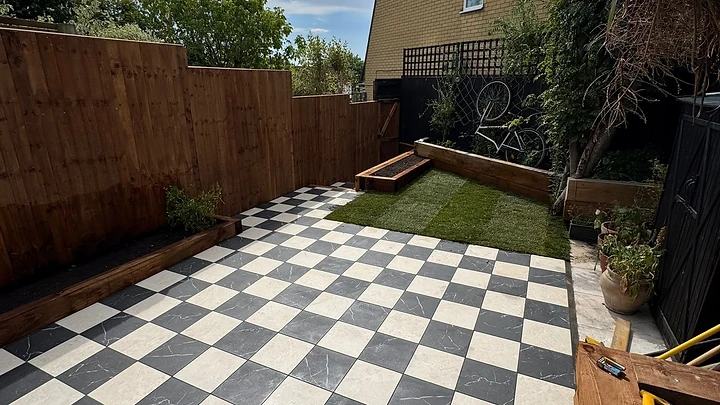
Let's say you have a typical semi-detached home in Orpington — a 35 m² rear garden patio area with moderate access, London clay subsoil, and you want large-format porcelain tiles with a simple rectangular layout and two steps down from the back door.
| Item | Estimated Cost | |---|---| | Excavation and soil removal | £550 | | Sub-base (MOT Type 1, 175mm) | £480 | | Sharp sand and cement bed | £280 | | Porcelain tiles (supply & fit, 35 m² at £140/m²) | £4,900 | | Two steps (porcelain, installed) | £650 | | Edging and pointing | £380 | | Skip hire and waste disposal | £320 | | Total | £7,560 |
This is a realistic mid-range project. Going up to premium 20mm thick porcelain, adding a channel drain, or using granite setts for the border would push this closer to £9,500–£11,000.
Local Planning Notes for Orpington and Bromley
Most rear garden patios in Orpington fall comfortably within permitted development rights and don't require planning permission, provided the work doesn't involve raising the ground level significantly or altering drainage in a problematic way.
Front garden paving — even partial — is subject to the 2008 rules mentioned above. If you're in a conservation area (parts of Chislehurst and Bromley town centre have designations), you may face additional restrictions. Permitted development rights can also be removed by a condition on your property's original planning permission, which is worth checking with Bromley Council before work begins.
We're familiar with local conditions and can advise during your site visit. You can also explore our patios service for more detail on what we typically install in this area.
Getting the Best Value
A few practical tips to avoid overspending or underspec'ing:
- Don't skimp on the sub-base. London clay is unforgiving. A thin sub-base leads to cracking and lifting within a few years.
- Get at least two to three quotes and make sure they're like-for-like — check whether soil removal, skip hire, and pointing are included.
- Ask about mortar mix. Some contractors use a weak mix to save time. For porcelain especially, a full bed of flexible adhesive mortar is essential.
- Consider drainage upfront. Retrofitting a channel drain after the patio is laid costs significantly more.
For a no-obligation assessment of your specific garden, get a free quote and we'll come out to measure up and discuss your options.
Frequently Asked Questions
How long does a patio installation take in Orpington?
For a typical medium-sized patio (25–40 m²), most installations take 3–5 working days from start to finish. Larger projects, complex designs, or those requiring significant groundworks can take up to two weeks. Weather can also affect schedules — pointing and adhesive mortar need dry, frost-free conditions to cure properly.
Do I need planning permission for a patio in Bromley?
For rear garden patios, planning permission is generally not required under permitted development rules. Front garden paving over 5 m² must use a permeable surface or drain to a soakaway or lawn to comply with legislation introduced in 2008. If you're in a conservation area or your property has had permitted development rights removed, you should check with Bromley Council before proceeding.
Why are patio quotes in London higher than national averages?
Several factors push costs up in South East London compared to national benchmarks. Labour rates in Greater London are higher, disposal and skip costs are elevated, and London clay soil typically demands deeper sub-bases and more groundwork preparation. Material delivery costs are also slightly higher in dense suburban areas with access restrictions. Expect to pay 10–20% more than quotes you might see in national price guides.
How do I choose between natural stone and porcelain?
Both are excellent long-term choices. Natural sandstone and limestone offer a traditional, organic look and are easier to cut on-site for complex shapes. Porcelain is more uniform, virtually maintenance-free, frost-proof, and doesn't require sealing. For busy family gardens or areas under heavy foot traffic, porcelain tends to outperform natural stone over time. If authenticity and a more natural aesthetic are priorities, good quality Indian sandstone or limestone is hard to beat. We cover both options in detail across areas we cover.
Prices in this guide reflect 2026 market conditions in the Orpington, Bromley, and South East London area. Individual quotes will vary based on site conditions, material choices, and project scope. All figures include VAT unless stated otherwise.
Orpington Services
Planning a project in BR5 or BR6? See our dedicated Orpington service pages: